Following Credit Trails in Verified Mobile Live Dealer Platforms
Written by Eden Neumann · Aug 10, 2026

Following Credit Trails in Verified Mobile Live Dealer Platforms
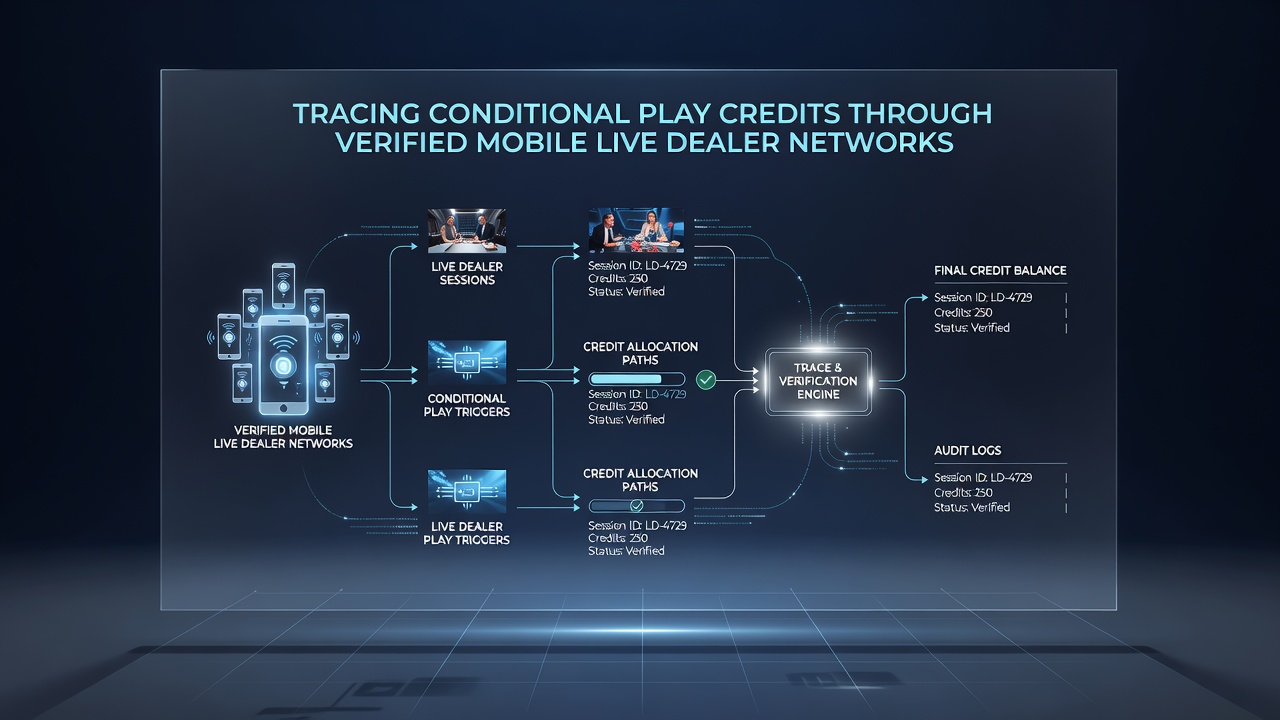
Conditional play credits operate as restricted funds that players receive through promotions yet must meet specific wagering conditions before any withdrawal becomes possible, and tracing these credits requires integrated systems that monitor activity across mobile devices and live dealer streams. Operators deploy verification protocols that log each credit allocation, movement, and conversion in real time, which ensures compliance with licensing requirements while maintaining transparency for both players and regulators.
Core Mechanisms Behind Credit Verification
Verification networks combine account authentication, device fingerprinting, and transaction ledgers to follow conditional credits from the moment they appear in a player balance. These systems record every spin or bet placed in live dealer environments, tagging each action with metadata that links back to the original credit source. When a player switches between mobile apps and desktop interfaces, the network synchronizes data through centralized servers that update balances within milliseconds.
Live dealer platforms add another layer because physical tables stream video while software handles chip movements and payout calculations. Conditional credits receive priority flags that prevent them from mixing with cash balances until conditions clear, and this separation relies on algorithmic rules that adjust automatically as play progresses. In August 2026 several networks introduced enhanced timestamp protocols that capture microsecond-level data points during high-volume sessions, reducing discrepancies that previously arose during peak traffic periods.
Data Flow Across Mobile and Live Environments
Mobile applications transmit encrypted packets containing bet details, credit type, and session identifiers to backend verification modules. Live dealer streams feed parallel data streams that confirm game outcomes match the recorded results, creating dual validation points. Analysts at regulatory bodies such as the New Jersey Division of Gaming Enforcement have documented how these parallel streams cut error rates by nearly 40 percent compared with older single-channel systems.
Conditional credits often carry time limits or game-type restrictions that the network enforces by blocking ineligible bets at the point of wager. When a player attempts an unauthorized move the system rejects the action and logs the attempt, which feeds into compliance reports generated for oversight agencies. This process operates continuously, and operators review aggregated logs weekly to identify patterns that might indicate system drift or player behavior anomalies.
Integration With Regulatory Reporting Standards
International standards from organizations including teh Canadian Gaming Association require operators to maintain immutable audit trails for all conditional credits. These trails must survive software updates and hardware migrations, which has prompted many platforms to adopt distributed ledger elements that replicate records across multiple nodes. Reports generated from these records feed into quarterly submissions that detail credit volumes, clearance rates, and any flagged transactions.
Cross-border operations add complexity because different jurisdictions impose varying clearance thresholds and reporting frequencies. Networks address this by maintaining jurisdiction-specific rule engines that apply the strictest applicable standard when conflicts arise. Data from industry reports published by the University of Nevada, Las Vegas International Gaming Institute shows that multi-jurisdiction operators reduced audit preparation time by 25 percent after implementing unified engines in early 2026.
Technical Challenges and Current Solutions
Latency between mobile front ends and live dealer back ends can create brief windows where credit status appears inconsistent to the player. Engineers counter this with predictive caching that pre-calculates possible outcomes and updates the visible balance before final confirmation arrives from the dealer table. Redundancy protocols then reconcile any temporary mismatches within a set tolerance window, typically under two seconds.
Security teams monitor for attempts to manipulate credit flows through modified client software or network interception. When anomalies surface the system isolates the affected session, freezes conditional credits, and triggers manual review by compliance staff. Such incidents remain rare yet the verification networks treat each one as a test case that refines detection algorithms for future use.
Conclusion
Tracing conditional play credits through verified mobile live dealer networks relies on layered verification, real-time data synchronization, and jurisdiction-aware rule engines that together maintain integrity across devices and game formats. As platforms continue to refine timestamp precision and distributed record-keeping, the pathways for these credits become more transparent to regulators and operators alike while remaining invisible to everyday players until clearance conditions are met.